
Where to Exchange Money in Vietnam (2026): Banks, ATMs, Wise, Revolut and Transfers
A practical guide for foreigners: where to exchange cash legally in Vietnam, ATMs and cards, Wise and Revolut, and how to send money from the US, EU, UK, Hong Kong and more (SEPA, Faster Payments, ACH/Zelle, FPS, PayPal).
Arriving in Vietnam with dollars, euros or pounds, or need to get money from your home bank to pay rent in Hanoi? Vietnam has many ways to get Vietnamese dong (VND), but they differ a lot in cost, speed and legality. This guide explains where to exchange money in Vietnam, how to move money from abroad with Wise, Revolut, PayPal and fast payment systems such as EU SEPA, UK Faster Payments, US ACH/Zelle or Hong Kong FPS, and the mistakes foreigners most often make.
The short answer
- Cash: exchange at a bank or a licensed exchange counter (airports, hotels of 3 stars and above). Bring your passport.
- Cards: withdraw VND from an ATM or pay by card. Multi-currency cards like Wise or Revolut usually give better rates than a traditional home-bank card.
- No Vietnamese bank account? No problem: get cash with a Wise or Revolut card at ATMs, or send yourself money for cash pickup through licensed services such as Western Union or MoneyGram.
- Avoid: exchanging with individuals, unlicensed gold shops or "money changers" on Facebook and Telegram.
Know the rule first: only banks and licensed agents may exchange currency
In Vietnam, foreign currency can only be bought and sold through banks and exchange agents licensed by the State Bank of Vietnam. Since 9 February 2026, under Decree 340/2025/ND-CP, individuals who buy or sell foreign currency with each other, or at places not licensed to exchange money, face penalties from a warning up to VND 100 million, and the money involved can be confiscated. The rules apply to both sides of the deal, including foreigners.
Many gold shops display exchange rates on a board, but a rate board is not a licence. A licensed agent can show its exchange agent certificate issued by the State Bank and the name of the bank it works for.
Option 1: Exchange cash at a bank
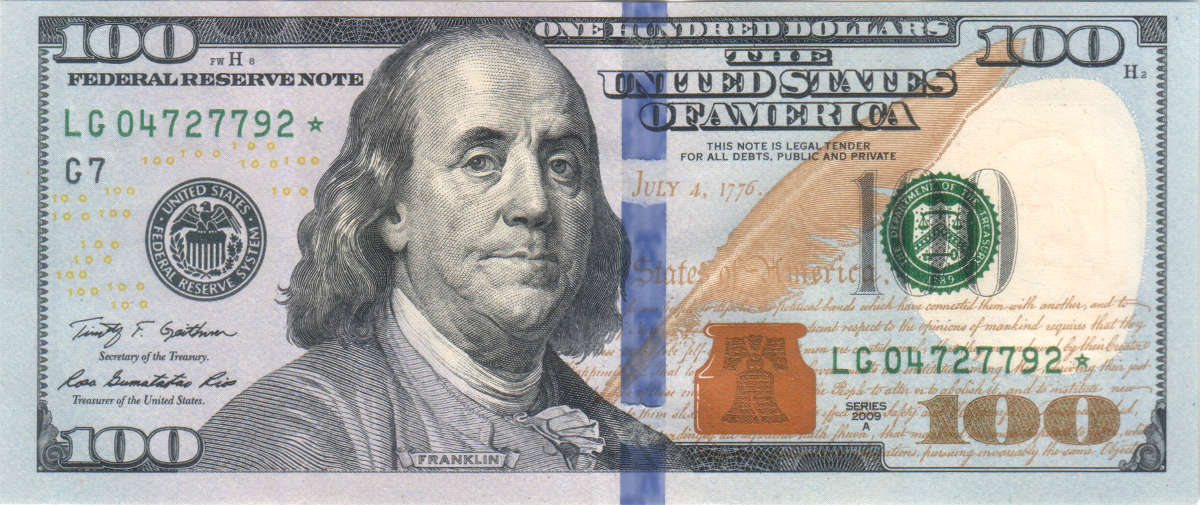
Photo: US 100-dollar note (series 2009). Source: Bureau of Engraving and Printing, Public domain, Wikimedia Commons.
Banks are the safest place to exchange cash: genuine notes, transparent rates and a receipt.
- Selling foreign currency (e.g. USD to VND): bring your passport; no proof of purpose is needed.
- Buying foreign currency (VND to USD): requires documents proving a permitted purpose, so it is harder for tourists.
- Major banks such as Vietcombank, BIDV, VietinBank, Agribank, Techcombank and ACB exchange the main currencies (USD, EUR, GBP, JPY, AUD, KRW…) at many branches.
- Banks pay less for small, old or damaged notes. Bring clean, recent USD 100 notes for the best rate.
You can compare live rates of the free market and Vietcombank on our exchange rate table.
Option 2: Licensed exchange counters at airports and hotels
Licensed counters operate at international airports (such as Noi Bai in Hanoi), border gates and hotels of 3 stars and above. They are convenient when you arrive, but airport rates are usually worse than in the city. Exchange only what you need for the first day or two.
Option 3: ATMs and paying by card
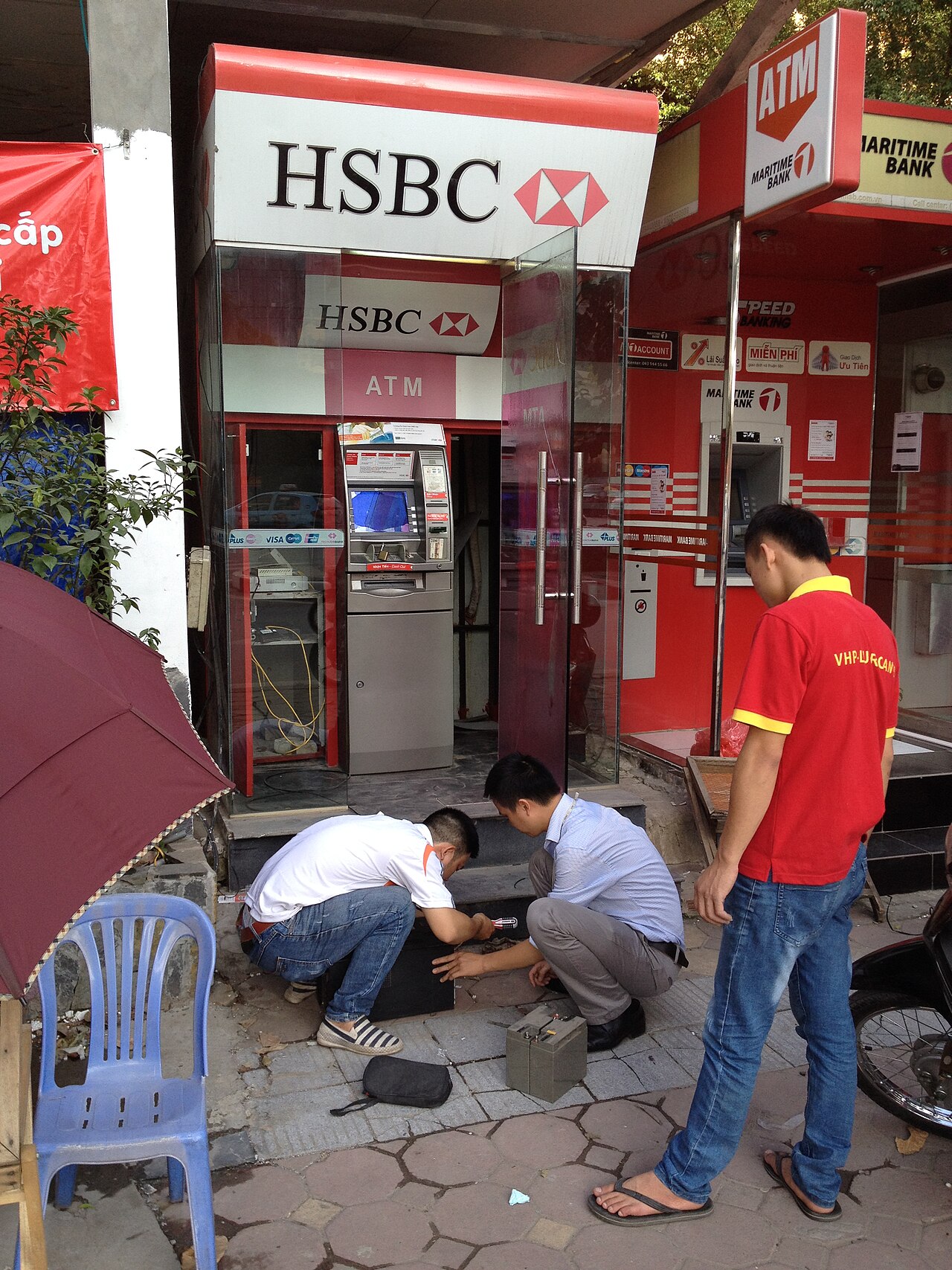
Photo: An ATM on Văn Cao street, Hanoi. Source: Phan Minh Tuấn, CC BY-SA 4.0, Wikimedia Commons.
ATMs are everywhere in Hanoi and other cities, and card payments are widely accepted in hotels, supermarkets, restaurants and ride-hailing apps.
- Expect a fixed fee per withdrawal from the Vietnamese ATM (often tens of thousands of VND), plus any fees from your own bank.
- ATMs limit the amount per withdrawal, so fewer, larger withdrawals keep fees down.
- When the ATM or card terminal offers to charge you in your home currency, choose "charge in VND" / decline conversion. The "home currency" option (dynamic currency conversion) usually uses a poor rate.
- Small street vendors, markets and taxis often still prefer cash.
Option 4: Wise and Revolut
Multi-currency accounts are popular with expats and long-stay visitors:
- Wise: hold many currencies, spend with the Wise card at close to the mid-market rate, and send money to Vietnamese bank accounts in VND.
- Revolut: exchange in the app and spend with the card; international transfers to Vietnam go via the SWIFT network.
- Both apps show the fee and rate before you confirm, which makes comparing easy.
Check each app's current fees and limits, as they change from time to time.
👉 Don't have Revolut yet? Open a Revolut account with our referral link.
Disclosure: this is a referral link. If you sign up through it, we may receive a reward from Revolut at no extra cost to you.
Sending money from abroad to Vietnam
Fast payment systems (US, EU, UK, Hong Kong…): they don't reach Vietnam directly
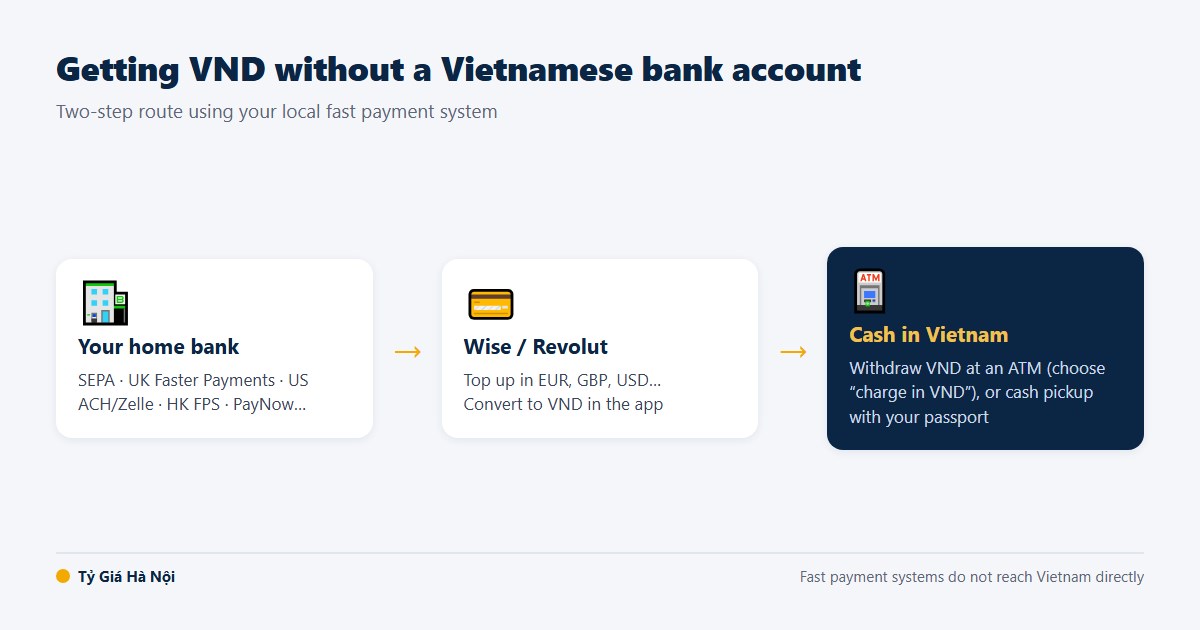
Getting VND in cash without a Vietnamese bank account
Most countries have a fast, cheap domestic payment system. These systems only move money inside that country or region, so you cannot send a payment straight to a Vietnamese bank with them:
| Country / region | Fast payment system | Currency |
|---|---|---|
| United States | ACH, Zelle, FedNow, RTP, domestic wire | USD |
| Eurozone (EU) | SEPA Credit Transfer, SEPA Instant | EUR |
| United Kingdom | Faster Payments (FPS), Bacs | GBP |
| Hong Kong | FPS (Faster Payment System) | HKD, CNY |
| Singapore | FAST, PayNow | SGD |
| Australia | NPP, PayID, Osko | AUD |
| Canada | Interac e-Transfer | CAD |
What you can do is a two-step route:
- Use your local fast payment system to fund a licensed international transfer service or multi-currency account (for example Wise or Revolut) cheaply in your home currency.
- Get cash in Vietnam: convert in the app and withdraw VND with the card at a Vietnamese ATM. No Vietnamese bank account is needed. (If you are paying a landlord or school, the service can also pay VND directly into their account.)
This route is often cheaper and faster than a traditional SWIFT transfer from a high-street bank. Which service supports VND payouts from your country, and at what fee, changes over time, so compare before sending.
SWIFT bank transfer
Any bank can send an international transfer to a Vietnamese account using the recipient's account number and the bank's SWIFT code (for example, Vietcombank: BFTVVNVX). It is reliable and suits large amounts, but fees can be high and intermediary banks may deduct charges. Choose OUR if the recipient must receive the full amount.
PayPal
PayPal is convenient for online payments, but converting and withdrawing money through PayPal is usually an expensive way to get VND because of currency conversion margins. Use it for paying online, not as your main way to move money.
Receive cash without a Vietnamese bank account
You don't need to open a bank account in Vietnam to get your money in cash:
- Wise or Revolut card at an ATM: fund the account from home (SEPA, Faster Payments, ACH…), convert to VND in the app and withdraw cash. The simplest option for most visitors.
- Cash pickup with Western Union or MoneyGram: send money to yourself from your home account or app, then collect VND cash at a partner bank or post office in Vietnam with your passport and the transfer code. Good for larger or urgent amounts.
- Exchange the cash you bring: clean USD, EUR or GBP notes at a bank or licensed counter.
Fees and rates differ between services and amounts, so compare the total VND you actually receive.
Common mistakes to avoid
- Exchanging with strangers online or on the street: scams with fake transfer receipts are common, and the deal itself is illegal.
- Accepting the "home currency" option at ATMs or card terminals.
- Changing all your money at the airport.
- Bringing old, torn or small USD notes, which get lower rates or are refused.
- Carrying more than USD 5,000 in cash (or equivalent) without declaring it at customs when entering or leaving Vietnam. Undeclared amounts can be fined up to VND 50 million.
Need advice? Book a free consultation
Every situation is different: a tourist for two weeks, a student paying tuition, a digital nomad paid in euros, or an expat with savings in a UK or EU account. We offer consultations on how to use Revolut, PayPal and your country's fast payment system (SEPA, UK Faster Payments, US ACH/Zelle, Hong Kong FPS, Singapore PayNow and more) to move your money to Vietnam and turn it into Vietnamese dong, the cheapest legal way for your case:
- Fast payment systems (US, EU, UK, Hong Kong, Singapore, Australia, Canada…): how to use your local account to fund a licensed transfer service, and which route gives you the most VND.
- Getting cash without a bank account: Wise/Revolut ATM withdrawals or cash pickup with Western Union/MoneyGram. We walk you through each step, from sending to collecting your cash in Vietnam.
- Revolut and Wise: setting up, exchanging in the app, and withdrawing VND in Vietnam.
- PayPal: when it makes sense, how to keep conversion fees low, and better alternatives for larger amounts.
- Exchanging in Vietnam: which banks, licensed counters or ATMs to use for your currency and amount, and how to read today's rates and the gap between bank and market rates.
- Customs: declaring cash when you enter or leave Vietnam.
Contact us:
- Phone: +84 877 079 927
- Email: [email protected]
- Or leave your details in the contact section and we will get back to you.
FAQ
Can foreigners exchange money at Vietnamese banks?
Yes. Selling foreign currency for VND at a bank only requires your passport.
Is it legal to exchange money at gold shops in Hanoi?
Only if the shop is a licensed exchange agent. Otherwise, both you and the shop can be fined, and the money can be confiscated.
What is the cheapest way to get VND?
For most visitors: a Wise or Revolut card at ATMs (choosing VND) or bank exchange of clean USD/EUR notes. For larger amounts without a Vietnamese bank account: cash pickup through a licensed service such as Western Union or MoneyGram. Ask us if you are unsure.
Do I need a Vietnamese bank account?
No. You can get cash with a Wise or Revolut card at ATMs, exchange cash at banks, or collect money sent through cash-pickup services with your passport.
Can I send money directly to Vietnam with Faster Payments, SEPA, Zelle or Hong Kong FPS?
No. These are domestic or regional systems and don't reach Vietnam. Use them to fund a transfer service or multi-currency account such as Wise or Revolut, or use an international (SWIFT) transfer.
Conclusion
The safest ways to get Vietnamese dong are banks, licensed exchange counters, ATMs and licensed transfer services like Wise. Avoid informal money changers: the rate may look better, but you risk scams, fines and losing your money. If you want help using Revolut, PayPal, SEPA, Faster Payments or your country's fast payment system to move money to Vietnam and exchange it, contact us for a consultation.
This article is for general information and is not legal or financial advice. Fees, limits and rules may change; please check with your bank or provider before making a transaction.